
2 September 2026
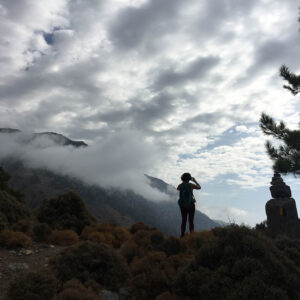
I have crossed many thresholds in my adult life.
I have left homes, countries, careers, relationships and whole ways of living, often stepping into the unknown long before I could see what would come next.
For many years, I thought I understood thresholds because I was willing to cross them.
At first, I barely felt the fear at all. What I felt was excitement, anticipation, the pull of what was next. Looking back, I imagine the fear was there too, but I was not yet able to feel it consciously. After crossing a few thresholds in this way, the fear began to make itself known. For a while I did not want to give it much space; I knew I had to move, and I did not know what I would do with the fear if I truly let myself feel it. Later, I learned to turn towards it, to work with it, to listen to what it was saying — and still, at times, I moved before the whole of me was ready. Only now do I feel I am beginning to understand threshold-crossing differently: not as overcoming fear, or even simply processing it before moving, but as allowing enough time for a way forward to emerge that more of me can come with.
Looking back, I can see that this willingness to move beyond what was known has also been part of what I have offered others. I have often been the person encouraging someone to trust the deeper movement, to move beyond fear, to step through the doorway when they already knew that staying where they were was no longer possible.
But the threshold I am crossing now is teaching me something different.
For perhaps the first time, I am not only listening to the part of me that knows change is necessary.
I am also listening to the part that is frightened.
The part that wants safety, stability and something solid beneath her feet.
I am not allowing that part to determine that nothing can change. But neither am I willing to abandon her in order to move forward.
And this has changed the way I am crossing.
I am moving more slowly.
I am less willing to force decisions simply because I cannot yet see another solution. I am giving situations time to unfold. I am noticing what happens in my body as different possibilities appear.
And I am waiting, as much as I can, for a way forward that feels more inclusive. A path that does not require one part of me to overpower another.
I don’t yet know whether this is something that could have been available to me during earlier thresholds. Perhaps not.
There are moments in life when we simply have to leave. There may not always be a gentle bridge between one reality and the next.
So I am not interested in rewriting my past or deciding that I crossed those thresholds incorrectly.
But I am becoming curious about a different question:
How do we cross a threshold well?
How do we honour the life that is asking to emerge without abandoning the vulnerable parts of ourselves along the way?
How do we distinguish between the fear that naturally accompanies the unknown and the deeper knowing that something is not right?
And how do we find our way when the people and structures that once orientated us can no longer show us where to go?
This last question has accompanied me for much of my life.
Thresholds can be profoundly lonely places.
Even when we are surrounded by people who love us, there are moments when nobody else can point us towards the next step. The old life is ending, while the new one has not yet taken form.
We are between worlds.
And perhaps this is one of the reasons my relationship with the more-than-human world has become so important to me.
The land. The body. Dreams. Symbols. Synchronicities. Astrology. The unexpected encounter with an animal. The subtle response that seems to arrive when we stop asking only other human beings for the answer.
I have come to experience this as a conversation with the cosmos — not something that gives us a set of instructions, but a larger field of relationship in which we can begin to orient ourselves.
Perhaps this is especially important at thresholds.
Because when the familiar voices no longer know the way, we may have to learn another kind of listening.
I sometimes think of the role I have played for others as something close to that of a midwife.
A midwife does not decide what is being born.
She does not create the life that is coming through, and she cannot control its timing.
She accompanies.
She listens.
She notices when movement is needed and when something needs more time.
And perhaps that is increasingly how I understand my own work.
Not as giving people frameworks or answers, but as accompanying the place where an old reality is loosening and something new is trying to take form.
Helping someone stay close enough to themselves — and perhaps close enough to the larger conversation taking place around them — that they can begin to recognise their own way through.
I am still learning this myself.
Maybe that is part of the work too.
To cross our own thresholds with enough attention that, eventually, what they teach us becomes something we can quietly offer to another person standing at the edge of theirs.